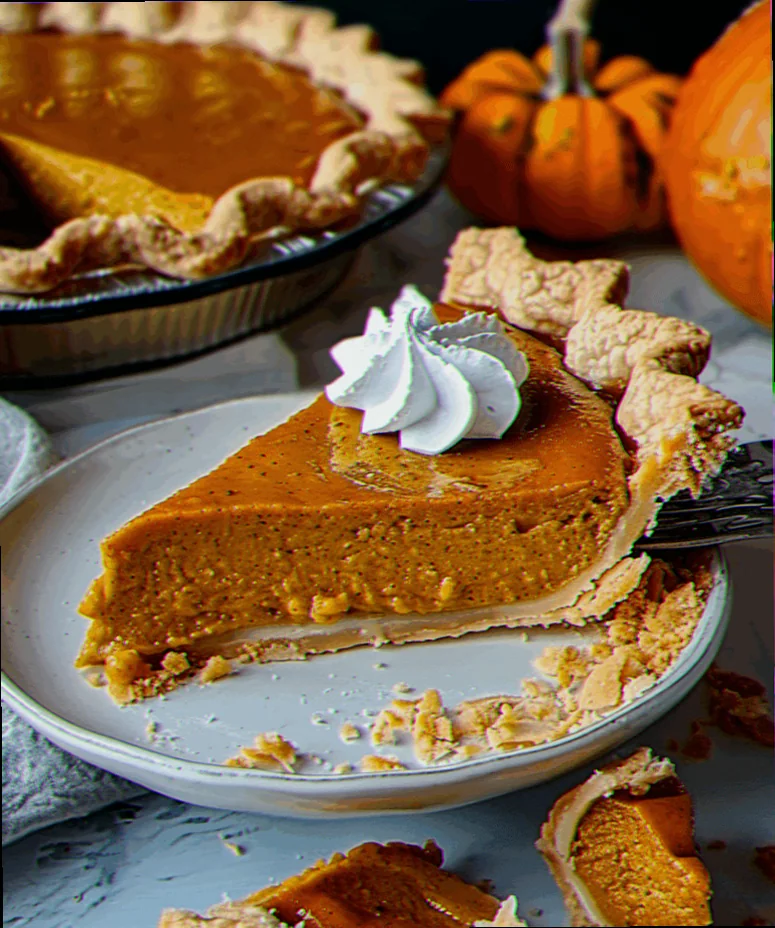
In the drafty lean-to of a seventeenth-century Massachusetts homestead, a Wampanoag woman and a settler from East Anglia stand over a bed of dying embers. There is no rolling pin, no ceramic pie dish, and no refined flour; instead, there is a heavy, ribbed “pompion,” its top sliced off and its cavity filled with wild honey, ginger, and the fatty milk of a recently imported cow. As the squash roasts directly in the ash, the flesh softens into a custard, creating a primitive, crustless precursor to a dish that would eventually define the American holiday ritual of Thanksgiving. This was not a dessert in the modern sense, but a survival mechanism—a marriage of Indigenous agriculture and European preservation techniques.
Where Pumpkin Pie Comes From — and Why It Was Invented
The pumpkin pie was born of necessity and the collision of two vastly different biological worlds. Before the arrival of Europeans, the Indigenous peoples of North America—specifically the Algonquian-speaking tribes of the Northeast—had spent millennia cultivating Cucurbita pepo. These squashes were prized for their hard rinds, which allowed them to be stored through the lean winter months, and their nutrient-dense flesh. To the Indigenous populations, the pumpkin was one of the “Three Sisters,” grown alongside corn and beans to create a self-sustaining ecosystem.
When English colonists arrived in the 1620s, they encountered a climate far harsher than the temperate fields of Britain. Their traditional cereal crops, like wheat, often failed in the rocky New England soil. The pumpkin became a crucial substitute. However, the English did not initially view the pumpkin as a luxury; they saw it as a “filling” food of the poor. The invention of the pie was an attempt to civilize the wild squash. By applying the European “pottage” or “pastry coffin” technique—a method used since the Middle Ages to preserve meat and fruit—settlers transformed the Indigenous gourd into a recognizable British format. The problem it solved was simple: how to make a rustic, abundant, and somewhat bland vegetable palatable and calorie-dense enough to sustain a family through a sub-zero January.
The Ingredients as Historical Artefacts
Each component of a pumpkin pie is a map of global trade routes, colonial exploitation, and agricultural evolution. To look at the ingredient list is to see the history of the seventeenth and eighteenth centuries in microcosm.
- Cucurbita moschata (The “Dickinson” Pumpkin): While we visualize the bright orange Jack-o’-lantern, almost all modern pumpkin pie—specifically the canned variety popularized by the Illinois-based company Libby’s in the 1920s—is actually made from the Dickinson squash. This tan-skinned, oblong fruit is more closely related to the butternut squash than the field pumpkin. It was selected for its lack of fibrous “strings” and its high sugar content, representing the industrial shift from diverse heirloom varieties to a singular, standardized monoculture.
- The “Warm” Spices (Cinnamon, Nutmeg, Ginger): These are the ghosts of the Dutch East India Company and the Silk Road. In the 1600s, nutmeg and mace were grown almost exclusively in the Banda Islands of Indonesia. The demand for these spices fueled bloody colonial wars and maritime expeditions. They were included in pumpkin pie not just for flavor, but as a status symbol; to serve a heavily spiced pie was to signal your connection to the global trade network. Their presence today is a vestige of the medieval European palate, which favored heavily spiced, semi-sweet vegetable dishes.
- Evaporated Milk and Refined Sugar: These ingredients represent the Victorian transformation of the dish. Originally, pies used heavy cream or “potage” thickeners. The introduction of evaporated milk in the late 19th century—a result of new sterilization technologies—allowed the dish to move from a seasonal farmstead luxury to a shelf-stable, year-round staple. The sugar, meanwhile, links the dish to the Caribbean plantation complex, where the labor of enslaved people made what was once a rare medicine into a ubiquitous caloric filler.
The Harvest Home — When and Why This Dish Is Made
The ritual context of pumpkin pie is inextricably linked to the “Harvest Home,” an ancient Northern European tradition of celebrating the final gathering of crops before the winter solstice. In its American iteration, the dish became the cornerstone of Thanksgiving, a holiday that was not formalized until the mid-19th century. Sarah Josepha Hale, the influential editor of Godey’s Lady’s Book, campaigned for decades to make Thanksgiving a national holiday, specifically promoting pumpkin pie as a symbol of Yankee (Northern) values, domesticity, and abolitionist identity.
Sharing the pie signals the end of the agricultural year. Its flavor profile—dense, spiced, and served at room temperature—is designed for a communal table where the oven space is occupied by a bird. It is a “holding” dish, one that can be prepared a day in advance, signaling a transition from the labor of cooking to the social ritual of the feast. In contemporary culture, the “Pumpkin Spice” profile has been decoupled from the actual ritual, becoming a seasonal herald of autumn that signals the shift in the consumer calendar from summer to “Q4.”
How Industrialization Changed the Pie Forever
The migration of pumpkin pie was not a geographical one—it remained largely a North American phenomenon—but a technological one. In the early 19th century, making a pumpkin pie was an arduous two-day process involving the butchering of a massive squash, steaming it, straining it through cheesecloth, and hand-beating the custard.
The turning point came in 1929 when the Dickinson squash was canned and marketed as “pumpkin.” This technological migration from the garden to the tin changed the texture of the dish forever. The rustic, sometimes watery, and deeply vegetal character of the fresh squash was replaced by a smooth, consistent, and highly concentrated puree. What was lost was the biodiversity of the squash family—varieties like the ‘Long Pie’ pumpkin or the ‘Cheese’ pumpkin vanished from the public consciousness, replaced by a singular, engineered flavor profile that emphasized the spices over the vegetable itself.
How to Make the Historical Custard — The Recipe in Full
This recipe bridges the gap between the 19th-century farmstead and the modern kitchen, utilizing the concentrated puree that has become the “authentic” standard, while respecting the spice ratios of the colonial era.
| Ingredient | Quantity | Why it’s here |
|---|---|---|
| Roasted Squash Puree (C. moschata) | 425g | Provides the structural base and earthy, vegetal foundation. |
| Evaporated Milk | 350ml | A Victorian innovation that ensures a silkier emulsion than fresh cream. |
| Large Eggs | 2 units (110g) | The coagulant that transforms the puree into a stable custard. |
| Dark Muscovado Sugar | 150g | Provides sweetness plus the molasses notes lost when refined sugar is used. |
| Ground Ginger | 5g | A digestive aid historically used to “cut” the heaviness of the squash. |
| Ground Cinnamon | 5g | The primary aromatic link to the 17th-century spice trade. |
| Ground Cloves | 1g | Adds a medicinal, “numbing” depth characteristic of early recipes. |
| Fine Sea Salt | 3g | Essential for oscillating the sweetness and brightening the dull squash notes. |
| Shortcrust Pastry (all-butter) | 1 disk | The “coffin” or vessel; provides the fatty, crisp contrast to the soft interior. |
Method: Begin by blind-baking your pastry. In the historical context, the crust was often thick and barely edible, serving only as a container; for modern palates, we roll the butter-rich dough thin and bake it at 190°C under weights until it is pale gold. This prevents the “soggy bottom” that plagued early colonial versions. In a large ceramic bowl, whisk the eggs into the sugar until the mixture is glossy and the granules have begun to dissolve—this ensures the custard will be smooth rather than grainy.
Slowly incorporate the squash puree, folding it in to avoid aerating the mixture; a pumpkin pie should be dense and creamy, not a souffle. Sift in the spices, ensuring no clumps remain, as a bite of concentrated clove can be overwhelming. Gradually pour in the evaporated milk while whisking gently. The color should shift from a deep, burnt orange to a muted, autumnal ochre.
Pour the filling into the pre-baked shell and place it in an oven set to 175°C. The custard is done when the edges have puffed slightly and the center retains a rhythmic, gelatinous jiggle when the pan is nudged. This usually occurs when the internal temperature reaches 78°C. Do not overbake, or the proteins in the eggs will tighten and cause the surface to crack—a common flaw that purists hide with whipped cream. Allow the pie to cool completely for at least four hours; this is a dish of patience, allowing the starches in the squash to fully set and the spices to bloom.
The Tension — What Authenticity Actually Means
The central tension in pumpkin pie is the “Canned vs. Fresh” debate. Purists often argue that roasting a fresh Sugar Pie pumpkin is the only way to achieve authenticity. However, from a historical and culinary perspective, this is a fallacy. The pumpkins available in grocery stores today are often bred for aesthetics, not flavor. They are watery and fibrous.
The “authenticity” of the pumpkin pie lies in its consistency and its spiced custard profile. Most professional bakers and food historians acknowledge that the canned Dickinson squash—while an industrial product—is actually closer to the dense, sweet squashes used in the 18th century than a modern carving pumpkin. The tension, then, is between the idea of the farm-to-table vegetable and the reality of the desired texture. To use a “fresh” pumpkin often requires a level of processing (straining, reducing) that modern home cooks find prohibitive, leading to the irony that the most “authentic” tasting pie is the one that comes from a 1920s-era industrial process.
What Pumpkin Pie Has Become — and What That Tells Us
Today, the pumpkin pie has been abstracted into “Pumpkin Spice.” The dish has moved from a vegetable-based survival food to a flavor profile that often contains no pumpkin at all. This evolution tells us that in the modern global palate, the idea of a season is more important than the ingredients of the season.
We have commodified the olfactory memory of the 17th-century hearth—the cinnamon, the nutmeg, the woodsmoke—and turned it into a consumer signal. Yet, the pie remains. Even in an era of molecular gastronomy and global fusion, the pumpkin pie remains stubbornly resistant to change. It is one of the few dishes that Americans, regardless of their background, expect to taste exactly the same way every year. It is a culinary anchor, a rare moment where the industrial present and the colonial past sit together at the table.
Related topics: Whipped cream for pumpkin pie recipe · Pumpkin pie recipe with baileys · Strasberg pie recipe
Questions About Pumpkin Pie
What is the single ingredient you should never substitute in pumpkin pie?
The “warm” spices, specifically nutmeg or mace, are non-negotiable. Structurally, you can swap the milk or the sugar, but without the specific volatile oils