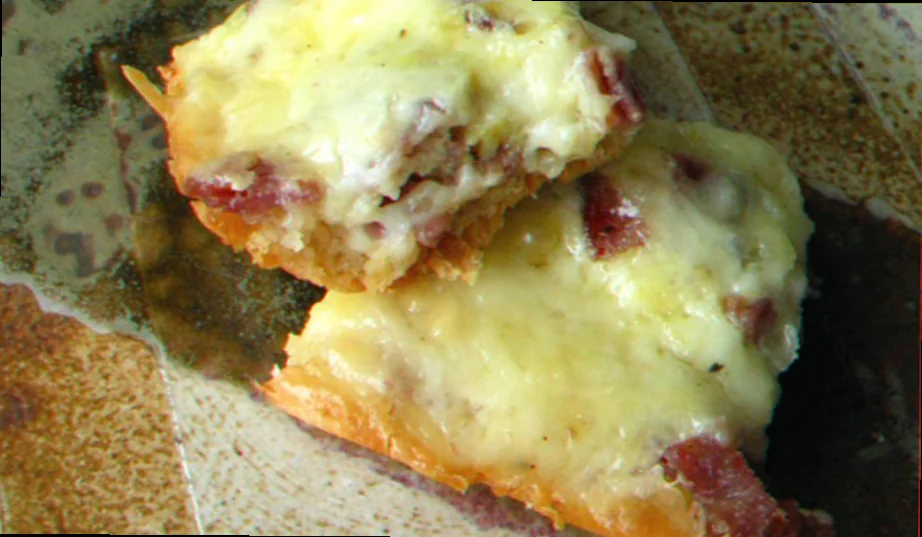
The most common catastrophic failure of the Salami Cheese Pie is the Lipid Migration, more commonly known as the “Oil Slick.” This occurs when the high fat content of the salami and cheese liquefies before the egg proteins set, resulting in a pie swimming in a pool of orange grease and a saturated, translucent crust. This guide will diagnose every mechanical and chemical failure mode—from the “Soggy Bottom” to the “Curdled Custard”—to ensure your next attempt achieves structural and culinary integrity.
What Perfect Salami Cheese Pie Actually Looks, Feels, and Tastes Like
The benchmark for this dish is a study in contrasting textures: a shatteringly crisp, golden-brown crust supporting a silky, cohesive custard studded with tender, savory meat.
| Stage | Success marker — what you should see / feel / smell / hear |
|---|---|
| Raw Assembly | Dough is cold to the touch (approx. 4°C); salami is diced into uniform 5mm cubes; custard is a pale, emulsified blonde with no visible streaks of egg white. |
| Mid-Bake | The aroma is dominated by toasted grain and warm spices (nutmeg/pepper); the edges of the crust are “Gilded Gold”; the center reaches 65°C and begins to puff slightly. |
| Finished | The internal temperature hits exactly 82°C–85°C; the surface is a matte “Deep Amber”; a gentle shake reveals a “Nuanced Jiggle” (like firm gelatin) rather than a liquid wave. |
| When Serving | A knife encounter produces a distinct “Dry Crunch”; the slice holds a 90-degree vertical edge without slumped filling; flavor is a balance of lactic tang, cured salt, and buttery pastry. |
The Ingredient Failures — Wrong Choices Before You Even Start Cooking
- The Salami Shrapnel: caused by using ultra-thin, pre-sliced deli salami → fix: buy a whole salami log (Genoa or Sopressata) and hand-dice into 5mm cubes to preserve moisture and texture.
- The Lactic Leak: caused by high-moisture “Fresh” Mozzarella or cheap “Salad” Cheeses → fix: use low-moisture, part-skim mozzarella or aged Provolone/Gruyère with a minimum 4-month age profile to ensure a stable melt.
- The Flour Slump: caused by using low-protein cake flour for the crust → fix: use All-Purpose flour with exactly 11–11.5% protein content to provide the structural “skeleton” needed to hold heavy fillings.
- The Greasy Mouthfeel: caused by room-temperature butter in the pastry → fix: use European-style butter (82%+ fat) chilled to 2°C and cubed; cold fat is the only way to create the steam pockets required for flakiness.
The Technique Failures — What Goes Wrong During Cooking
- The Soggy Bottom: the base is pale, wet, and raw → caused by skipping the blind bake or failing to create a moisture barrier → fix: blind bake the crust at 190°C with ceramic weights for 15 minutes, then brush with a “Wash Seal” (beaten egg white) and bake for 2 more minutes to waterproof the pastry before adding filling.
- The Curdled Custard: filling looks like wet scrambled eggs or weeps clear liquid → caused by protein over-coagulation from oven temperatures exceeding 190°C → fix: bake the assembled pie at a steady 175°C to allow eggs to set slowly into a smooth matrix.
- The Salami Sinkhole: all meat pieces are clustered at the bottom of the pie → caused by a low-viscosity custard or oversized meat chunks → fix: toss the diced salami in a teaspoon of flour to provide “grip” and ensure the custard contains at least 3 large eggs per 250ml of dairy to increase density.
- The Volcano Rise: the pie domes aggressively in the center and then cracks → caused by over-beating the eggs, which incorporates too much air → fix: whisk the custard gently by hand in a figure-eight motion; do not use a blender or high-speed whisk.
The Equipment Failures — When Your Tools Are the Problem
- The Glass Pan Pitfall: Glass is a poor heat conductor and often leads to an undercooked bottom crust even if the top looks done. Use a Heavy-Gauge Metal Tart Pan with a Removable Bottom for maximum heat transfer and easy extraction.
- The Blind Weight Failure: Using too few pie weights allows the sides of the crust to “slump” down the pan. Use enough weights (or dried beans) to fill the crust to the very brim during the initial bake.
- The Temperature Guesswork: Relying on “visual cues” for doneness is the leading cause of the Curdled Custard. Use an Instant-Read Digital Thermometer; the pie is done at 82°C.
The Full Recipe — Built Around Preventing Every Failure Above
- All-Purpose Flour — 250g — [Prevents The Flour Slump; provides gluten structure]
- Unsalted Butter (Chilled, 2°C) — 125g — [Prevents a “tough” crust; creates steam pockets]
- Whole Salami Log — 150g — [Prevents The Salami Shrapnel; provides bite and juice]
- Low-Moisture Provolone/Gruyère — 150g — [Prevents The Lactic Leak; ensures a stable melt]
- Heavy Cream (36% fat) — 200ml — [Prevents filling breakdown; fat stabilizes egg proteins]
- Whole Milk — 100ml — [Balances richness]
- Large Eggs — 4 units — [The primary structural binder]
- Egg White (Reserved) — 1 unit — [The “Wash Seal” to prevent the Soggy Bottom]
- Nutmeg & Black Pepper — 2g each — [Prevents The Bland Void]
Method:
- Pulse and Chill: Combine flour and cold butter in a processor until “pea-sized” crumbs form. Add 3–4 tbsp ice water. — Prevents gluten over-development — success marker: Dough holds together when squeezed but isn’t “sticky.”
- The Structural Chill: Wrap dough and refrigerate for 60 minutes. — Prevents crust shrinkage in the oven.
- The Blind Bake: Roll to 3mm, fit into metal pan, fill with weights, and bake at 190°C for 15 mins. — Prevents the Soggy Bottom.
- The Waterproofing: Remove weights, brush with reserved egg white, bake for 2 mins. — success marker: The crust surface looks “varnished” and dry.
- The Component Prep: Dice salami into 5mm cubes and grate cheese coarsely. Toss together. — Prevents uneven distribution.
- The Custard Emulsion: Whisk eggs, cream, milk, and spices gently. — Prevents The Volcano Rise.
- The Assembly: Place meat and cheese in the crust first, then pour custard over. — Prevents overflow.
- The Precision Bake: Bake at 175°C until the center reaches 82°C. — Prevents The Curdled Custard — success marker: The center has a “High-Frequency Jiggle” when tapped.
How to Rescue Salami Cheese Pie When It Has Already Gone Wrong
- If an Oil Slick has formed on top: Do not attempt to stir. Use a folded paper towel to gently “blot” the surface while the pie is hot. This removes excess lipids without damaging the custard set.
- If the crust is pale but the filling is setting: Place the pie on the lowest rack of the oven and increase the bottom heat if possible (or place on a preheated pizza stone). This can sometimes “save” a Soggy Bottom mid-bake.
- If the custard has curdled/wept liquid: This cannot be reversed. However, you can salvage the flavor by topping the pie with a thin layer of extra cheese and broiling it for 60 seconds to create a “crust” that hides the texture failure.
- If the pie is “Slumping” (falling apart when cut): It is likely under-baked or too hot. Refrigerate the pie for 4 hours. The fats and proteins will “set” in the cold, allowing for clean slices that can then be gently reheated.
Make-Ahead: Which Failures This Introduces and How to Avoid Them
The primary failure of make-ahead savory pies is Moisture Migration. Over time, the moisture in the custard will migrate into the crust, turning it into a “Grey Paste.”
- Storage Fix: Never wrap a warm pie. Allow it to hit room temperature (approx. 21°C), then refrigerate uncovered for 2 hours before wrapping in foil. This prevents condensation from raining back onto the crust.
- Reheating Protocol: Avoid the microwave (which causes “Pastry Toughening”). Reheat in a 150°C oven for 12–15 minutes. This “re-crisps” the butter in the crust while gently warming the custard without hitting the “Curdle Point.”
Related topics: Whipped cream for pumpkin pie recipe · Pie fulling recipe · Pecan sour cream pie crust recipe
Diagnostic FAQ — Real Failures, Real Fixes
My pie turned out “Rubbery and Bouncy” — what went wrong?
This is Over-Coagulation. You either used too many eggs or cooked it to an internal temperature exceeding 90°C. The egg proteins have tightened so much they’ve squeezed out all the moisture. Next time, use the 82°C thermometer rule.
It looked right but tasted “Aggressively Salty” — where did I go wrong?
This is a Concentration Failure. Salami and cheese both contain high sodium; if you added standard salt to the custard, you overloaded the palate. Fix: Never salt the custard for a Salami Cheese Pie until you have tasted the specific batch of salami you are using.
Everything looked perfect until I cut it—then it “Blew Out” at the sides.
This is Premature Extraction. You cut the pie while the internal lipids were still liquid. A savory pie requires a “Rest Period” of at least 20 minutes to allow the cheese and egg matrix to stabilize. If you cut it at 85°C, it will fail; cut it at 55°C, and it will hold.